
Parnavaz Mepe st. 65

Layouts and prices for building on Parnavaz Mepe st. 65


Parnavaz Mepe st. 65 on the map of Batumi
Construction progress
We take photos of complex from same spots, to show real status and dynamics of development.
The latest update — ოქტომბერი 2026


Mortgage in Parnavaz Mepe st. 65
Project characteristics
| 🟧 Number of buildings | 1 |
| 🟧 Number of floors | 8 |
| 🟧 Construction technology | monolithic-frame |
| 🟧 Elevator | yes |
| 🟧 Cadastral number | 05.22.39.006 |
| 🟧 Parking | underground parking (9 parking spaces) |
| 🟧 Apartment renovation | black frame |
| 🟧 Apartments area | 31.4–181 m2 |
| 🟧 Number of apartments | 46 |
Information about the project
Residential complex on Parnavaz Mepe St., 65 in Batumi reflects the principles of advanced architecture, combining innovative construction solutions with modern engineering systems. The location near the seaside promenade sets high standards for structural quality and apartment functionality, influencing the design and characteristics of the properties through the prestige of the surroundings and proximity to the sea.
Advantages
- developed location;
- convenient transport accessibility;
- enhanced sound insulation of premises;
- expressive facade design;
- high level of protection and security;
- well-maintained courtyard area;
- multi-level lighting;
- functional and well-thought-out layouts;
- european-standard apartments;
- only 46 apartments;
- three-meter-high ceilings;
- carefully designed landscape greenery;
- low-noise passenger elevators;
- full connection of engineering communications;
- stylish entrance lobby design;
- adaptation for residents with limited mobility;
- large windows with energy-saving characteristics;
- promising investment opportunities;
- mortgage programs;
- reliable and promising developer.
About the location
The residential complex on Parnavaz Mepe Street, 65 is integrated into the established urban development while considering the scale of the surrounding mid-rise buildings. The height parameters and silhouette are maintained in proportions corresponding to neighboring structures, supporting the integrity of the district’s visual perception. The natural landscape structure has been preserved: green areas and the natural relief are incorporated into the overall composition without radical intervention.
The walking route to the sea coast takes less than ten minutes. Such proximity makes walks along the waterfront part of the daily routine. Regular contact with sea air and the coastal line expands leisure scenarios—from morning runs to evening walks. The seaside becomes a logical continuation of everyday routes rather than a rare destination.
Traffic load is distributed rationally: major roads with active traffic are located approximately 200 meters away. This reduces acoustic impact and preserves the calm character of the surrounding territory. At the same time, connection with other parts of the resort remains efficient due to convenient exits and a well-planned road network.
The surrounding environment is complemented by walking alleys and green routes. Pedestrian paths connect the residential complex with parks and recreational areas, maintaining continuity of movement without crossing intensive traffic flows. Landscaping performs a sanitary function, participates in microclimate regulation, and enhances the visual depth of the site.
The infrastructure of the district covers everyday services while natural elements remain an important part of the surroundings. A balanced ratio of buildings and green spaces increases the investment attractiveness of the property and supports the long-term sustainability of the location.
Taken together, the placement parameters, distance to the sea, and well-organized road connections create a stable residential environment. The new development combines the calm atmosphere of the coastline, green surroundings, and rationally structured infrastructure, forming a balanced rhythm of everyday living.
What is nearby
The location is characterized by well-developed infrastructure: key services and facilities are concentrated within a 5–10 minute drive. Everyday tasks can be solved without significant time costs thanks to a dense network of retail and service outlets.
Groceries and everyday goods are available in stores of different scales—from small local shops to large retail operators. Among the nearest are Goodwill, Carrefour, Agrohub, Jibe, and the Hopa market. The assortment includes basic groceries, farm products, imported goods, and gastronomic delicacies. Specialized bakeries and confectioneries also operate nearby, including Fresh Bakery with a wide selection of pastries and desserts. Cafes, coffee shops, pizzerias, and sushi bars offering diverse cuisines are located nearby as well.
Infrastructure for car owners includes service stations, auto repair centers, fuel stations, and car washes. The presence of specialized services reduces time spent on vehicle maintenance and scheduled inspections. For those who prefer physical activity, fitness centers, the Forward Batumi football club, a rugby field, and the Dinamo Batumi stadium operate nearby, where matches and training sessions are regularly held.
The healthcare sector is represented by a wide range of institutions. Nearby operate the Batumi Republican Center for Maternal and Child Health Protection, private clinics, pharmacies, regional hospitals, the International University Hospital, and a referral hospital. A veterinary clinic is available for pet owners. Beauty salons, hairdressers, and spa salons complement the list of everyday services.
For leisure and walks there are water and park areas. Popular locations include the water park, dolphinarium, zoo, seasonal ice rink, and Lake Ardagani with its fountain complex. For walking, the 6 May Park and the seaside promenade with access to the yacht club are suitable.
The educational environment includes Schools No. 3 and No. 7, the Georgian-American School, the XXI Century Gymnasium, Batumi International University, preschool institutions, and the Maritime Engineering College. The concentration of educational institutions of various levels expands opportunities for education.
Overall, the infrastructure of the location covers retail, sports, healthcare, education, and leisure. Such a density of services increases the attractiveness of the property for active individuals and family lifestyles, as well as for those who value efficient time management and a variety of urban functions within a short distance.
Transport interchange
A bus stop is located 135 meters away, from which buses No. 1, No. 3, No. 4, No. 7, No. 9, No. 10, No. 10a, No. 11, No. 13, No. 15, and minibus No. 25a operate at regular intervals. The average interval between departures is eleven minutes, allowing residents to plan trips without significant time losses and adjust routes throughout the day.
The road network covers key directions of the resort area. Within 740 meters is the sea port—an important logistics hub and a landmark for navigation along the waterfront zone. The road to the Argo cable car station and the Old Bus Station takes approximately 13–15 minutes. These points connect central districts with panoramic viewpoints and intercity routes. At a distance of about three kilometers operates the Metro bus terminal serving routes outside the city. For railway travel and interregional bus lines, Batumi Central and Batumi-Passenger stations are used; the journey to them takes approximately ten minutes by car. Air transport is represented by Chorokh International Airport—the road to the terminal takes less than twenty minutes, which is convenient for business trips and tourist flights.
From a logistics perspective, the district demonstrates strong balance: city routes are available within walking distance, while railway and bus hubs as well as air connections are within a short drive. Such a configuration of transport links reduces travel time and expands mobility opportunities both within Batumi and beyond.
Parameters of the new development
On Parnavaz Mepe St., 65 there is an eight-story building with a monolithic frame structure. The load-bearing scheme is designed with a safety margin: the reinforced concrete frame distributes loads evenly, increasing resistance to external impacts. Advanced monolithic construction technology allows precise maintenance of slab and vertical element geometry, thanks to which the facade retains a clear rhythm of lines and proportions. The structural grid is arranged in strict accordance with the design documentation, minimizing deviations and improving the quality of the final result.
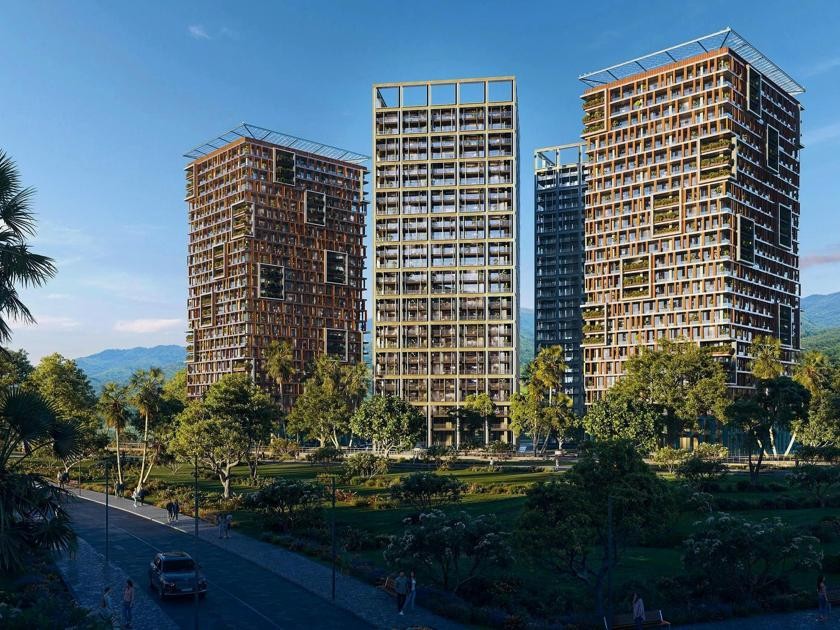
The new complex is a distinctive example of mid-rise development with clearly structured facade plasticity and an emphasis on horizontal lines. The volumetric composition is based on the principle of cascading tier formation: projecting floor slabs create a rhythmic pattern that gives the building dynamism and visual depth. The main facade is organized through the alternation of open terraces and glazed planes. Wide balconies wrap around the levels along the perimeter, forming extended horizontal lines. The railings are made of glass, enhancing the feeling of lightness and emphasizing the graphic character of the silhouette. The contrast between the light cladding of load-bearing elements and warm inserts in the finishing creates expressive layering.
The corner part of the building is designed as a compositional accent: the sequential shift of balcony lines forms the effect of a stepped rotation of the volume. This approach strengthens the visual perception of the complex at the intersection and gives it the status of a dominant element within the mid-rise district. The upper level is completed with a wide roof overhang that visually unites the entire structure and adds completeness to the silhouette. The first floor is designed in a more restrained manner. Panoramic glazing of storefront windows forms a transparent base, visually lightening the mass of the upper levels. Vertical supports are clearly readable and structure the facade, giving the composition stability.
The material palette is maintained in restrained shades: light stone or decorative plaster is combined with dark window frames and graphite inserts. As a result, the facade gains expressive depth, while shadows from the balcony slabs enhance the play of light throughout the day. At night the complex reveals a new character. Architectural lighting is предусмотрена: linear fixtures emphasize horizontal bands, accentuate corners, and highlight the rhythm of terraces. The soft glow enhances the geometry of the volume and makes it a noticeable element of the Batumi skyline while maintaining restrained elegance.
Overall, the facade plasticity, proportions, and careful detailing create an image with clear geometry and an expressive silhouette that organically fits into the development of Parnavaz Mepe Street and establishes a new visual landmark.
The engineering concept is focused on operational stability. Communication systems are integrated into the structure of the complex and designed for long-term service. Planning schemes provide rational distribution of space, eliminating excessive corridors and inefficient zones. Internal spaces are designed with consideration for practical use and logical movement.
Technical equipment includes an automated fire alarm system and connections to centralized water supply, sewage, and power networks. All units are installed in accordance with current regulations and designed for stable operation under intensive load. The engineering base establishes a foundation for operational reliability for many years.
The entrance group is organized through a spacious lobby with restrained finishing. Common areas are designed in a unified style and reflect the strict concept of the project. Navigation is intuitive, lighting is evenly distributed, and materials are selected with durability in mind.
Vertical communication between floors is provided by a passenger elevator designed for regular use. It connects residential levels with the entrance area and commercial premises on the first floor, increasing the functionality of the building. Entrance structures, elevator units, and internal passages are adapted for residents with limited mobility. The width of openings and the absence of thresholds simplify movement and expand the range of potential residents.
Overall, the technical characteristics, structural precision, and well-thought-out organization of internal zones form a stable operational model. The complex is oriented toward practicality, durability, and rational use of space, offering a balanced structure for everyday living and long-term ownership.
Improvement of the internal territory
The concept of the project is built around parameters that influence everyday routines and the rhythm of time spent on the territory. Priority is given to the structural organization of the site, where functionality determines the planning logic. Attention is focused on regulating flows, zoning separation, and engineering discipline, thanks to which the environment is perceived as orderly and stable.
The video surveillance system operates around the clock; monitoring is carried out without excessive interference in everyday processes. The landscape structure follows a unified geometry. Pedestrian alleys are laid out according to movement trajectories, recreation areas are distributed evenly, and small architectural forms are placed with visual balance in mind. The territory performs applied functions: recreation, short-term stay, and transit between entrance groups. Decorative elements support the overall composition, while practical function remains primary.
The first floor is allocated for commercial premises. Their placement is designed to separate flows: visitors of services use separate entrances, preserving the privacy of internal zones. The infrastructure includes spaces for a grocery store, coffee shop, yoga studio, and other everyday services. Activity on the first level enhances the dynamics of the facade line and adds diversity to building usage scenarios.
The transport scheme is designed with separation of pedestrian and vehicle routes. Access roads are placed outside recreational zones, reducing noise levels and improving safety. Landscaping is systematically integrated into the site planning: trees with dense crowns, shrubs of various heights, and flowering flowerbeds are planted. Vegetation performs sanitary functions—retaining dust, participating in microclimate regulation, and reducing surface overheating during warm seasons. Additionally, green accents structure visual perception and soften the geometry of the development.
Taken together, the planning and engineering solutions establish a clear order of territory use. The courtyard functions as an organized system where movement, recreation, and service processes are distributed without conflicts or intersections. Such structuring increases the operational stability of the building and supports a balanced rhythm of everyday living.
About apartment sales
The residential complex on Parnavaz Mepe St., 65 includes a limited number of apartments, which increases privacy and simplifies the organization of internal infrastructure. The planning range is focused on rational use of space and clear zoning. Studios starting from 31 m², as well as two- and three-room options from 45 to 181 m², are available for sale. The floor areas are distributed with everyday living scenarios in mind: isolated bedrooms, dedicated kitchen-living areas, spaces for storage systems, and full bathrooms are provided.
Apartments are offered for purchase with basic preparation of internal surfaces and engineering systems. The premises are already equipped with installed communications: electrical lines, water supply, and sewage are connected, and outlets for equipment installation are предусмотрены. Internal partitions are installed according to the approved layout. Zoning is clearly implemented, allowing the functional structure to be immediately understood after acceptance.
Floor bases are выполнены as cement screed leveled to the required level. The surface is ready for laying various coverings: natural parquet, ceramic tiles, laminate, or elastic materials. Walls are leveled and suitable for painting, applying decorative compositions, or wallpapering.
Such equipment provides owners with wide opportunities for individual interior design. Basic technical readiness accelerates the transition to selecting materials, lighting scenarios, and furniture items. At the same time, quality control remains transparent: key structural elements are already completed, while the final appearance is determined by the owner’s preferences and the chosen design concept.
Ceiling height reaches three meters. Room proportions gain additional depth, improving air circulation and light distribution. Balconies are designed in a laconic style and have an open format. They are suitable for placing compact furniture, greenery, or arranging a private relaxation area. From the upper floors panoramic views of the resort city open up, adding additional value to the location and strengthening the investment potential of the property.
Financial conditions are designed for various categories of buyers. Payment is possible using personal funds or mortgage programs from TBC Bank. Sales department specialists accompany clients at all stages of the purchase process, providing explanations on legal and financial issues. Additional information can also be found on the official website.
The new development combines modern engineering technologies with an expressive facade appearance. The structural scheme is designed from the perspective of reliability and operational stability. The internal arrangement follows the principles of rationality: space is distributed without excessive transitional zones, and communication nodes are integrated into the overall structure of the building. As a result, a property format is created that is oriented toward functionality, restrained aesthetics, and long-term relevance.
Construction company
Comfort Building positions itself as a developer focused on the practical value of the buildings it constructs. The first completed projects already demonstrated a well-considered strategy: combining an expressive external appearance with a rational structural scheme in order to create a cohesive and functionally justified product. The company’s activity is based on analysis of market demand and operational scenarios, which makes it possible to deliver properties with a clearly calculated structure. Priority is given to internal organization: planning solutions are based on movement logic and load distribution, engineering systems are integrated into the building structure without unnecessary elements, and the plasticity of facades reflects structural discipline.
The company organizes its work around specific technical tools and adaptive technologies designed for changing operating conditions. Construction processes rely on modern calculation methods and quality control systems, while the external appearance is maintained in a restrained style with emphasis on geometry, proportions, and durable materials. During design, operational loads, energy efficiency requirements, sound insulation parameters, and engineering stability are taken into account. The result is real estate designed for intensive use without loss of functional characteristics.
The developer’s strategic direction is aimed at developing property segments with prospects for long-term liquidity. The portfolio is dominated by formats oriented toward stable demand and flexible planning configurations. The focus is placed on technological resources as well as the possibility of transforming internal spaces according to the changing needs of owners. Thanks to this approach, properties remain relevant regardless of market dynamics and urban development trends.
The developer’s work demonstrates a стремление toward structural integrity. Real estate is viewed as a tool of everyday functioning rather than a static investment. As a result of Comfort Building’s activities, buildings are created with a clear logic of internal organization and a stable structural scheme. Rational distribution of areas, engineering expressiveness, and strict facade geometry work within a unified system of coordinates. Such a development vector strengthens the developer’s position in the market and sets a benchmark for the long-term practical value of constructed real estate.
Maybe you are interested in other projects




Which apartments are available for sale in Parnavaz Mepe st. 65 in Batumi?
For sale are studios, 2-room, 3-room.