
Airport Highway, 82v

Layouts and prices for building on Airport Highway, 82v
Airport Highway, 82v on the map of Batumi
Object documents
Construction progress
We take photos of complex from same spots, to show real status and dynamics of development.
The latest update — September 2026


Mortgage in Airport Highway, 82v
Project characteristics
| 🟧 Number of buildings | 1 |
| 🟧 Number of floors | 6 |
| 🟧 Construction technology | monolithic-frame |
| 🟧 Elevator | yes |
| 🟧 Cadastral number | 05.32.01.911 |
| 🟧 Parking | ground level parking |
Information about the project
Residential complex on Airport Highway 82v in Batumi is a modern development designed with a strong focus on optimizing internal layouts and maximizing efficient use of space.
Advantages
- area with high business and social activity;
- quick access to the promenade and seaside;
- educational institutions nearby;
- stylish facade design with expressive geometry;
- enlarged window openings for improved natural light;
- presentable entrance group design;
- use of durable and proven materials;
- modern-level engineering systems;
- landscaped courtyard with organized infrastructure;
- gated perimeter with access control;
- 24/7 video surveillance and security control;
- increased ceiling heights;
- low-noise elevator equipment;
- private parking;
- connection to centralized utility networks;
- variety of layouts for different needs;
- accessibility for people with reduced mobility;
- options for both permanent residence and rental;
- competitive pricing level;
- mortgage options available through a partner bank.
Location
The residential complex on Airport Highway 82v is located within a fifteen-minute walk from the coastline and well-equipped beaches. Slightly closer is Lech and Maria Kaczynski Park — a large green area designed for walking, jogging, and outdoor activities.
The road network benefits from proximity to one of the main city arteries: a high-traffic road runs approximately half a kilometer away. This simplifies access to different districts and reduces travel time for daily commuting. Walkable access to key destinations decreases reliance on private transport and makes daily movement more predictable.
The surrounding area includes a wide range of everyday services. Nearby are retail outlets, dining venues, and social infrastructure facilities. This distribution allows residents to handle daily tasks without long trips and helps optimize everyday routines.
The location combines several key advantages: proximity to the sea, access to green recreational areas, and developed infrastructure. This creates a variety of use scenarios — from peaceful relaxation to an active urban lifestyle. The balanced placement of key amenities makes this location practical both for permanent residence and short-term stays with flexible time planning.
Local infrastructure
Walking access to essential services is organized within a short distance. Within five minutes there are hotels, bank branches, cafes and restaurants of various formats, as well as a Burger King fast food outlet. The surrounding environment covers daily needs without requiring long commutes and simplifies everyday logistics.
At a short distance is a large shopping and entertainment center — Metro City. It includes a variety of retail stores, grocery supermarkets, dining venues, and gaming facilities. The concentration of services in one place expands leisure options and saves time on everyday tasks.
Within a radius of up to two kilometers, there is a wide range of commercial and service facilities. These include chain supermarkets, construction supply stores, small grocery shops, gas stations, confectioneries, and cafes. The distribution of retail and service points allows flexible shopping routes and choice based on assortment and pricing.
Social and educational infrastructure is represented by several significant institutions. The Republican Center for Maternal and Child Health operates here, providing family-oriented medical services. The Henri Maritime Engineering College trains specialists for the maritime industry. The educational cluster is complemented by Batumi International University and an international university hospital combining medical practice with research activities. Within a few minutes by car there is the Jibe chain hypermarket and the Forward football club.
A twenty-minute walk provides access to recreational and entertainment locations. Among them are the Euro Park water park, popular for seasonal leisure, and the distinctive Wave House building known for its unusual shape. In the same direction are a rugby stadium and Lake Ardagani with evening light and music shows.
The established infrastructure covers everyday needs, education, healthcare services, and leisure options. The layout of facilities allows building routes of varying duration — from short shopping trips to longer walks with access to entertainment venues and natural locations.
Transport accessibility
The transport network is organized through several points within walking distance. The nearest bus stop is just 320 meters away. The following routes pass through it:
- buses No. 2, 9, 12, 16, 77 towards Shuakhevi;
- minibuses No. 20, 22, 26, 30, 33, 39, 49, 56, 77, 88, 118, 119, 144, 145, 166, 172, 174, 199, 202, 205, 232, 400, 401, 402, 403, 404, 406, 408, 409, 410, 411, 412, 413, 414, 416, 417, 418, 420, 448 towards Zeda-Chkhutuneti, Kveda-Chkhutuneti, Nigazeuli, Khulo.
The interval between departures is approximately ten minutes, ensuring a steady transport flow and reduced waiting times.
Larger transport hubs are located within several kilometers. The old bus station, seaport, and the lower station of the Argo cable car are about five kilometers away. These points are connected to both tourist and business flows and provide access to sea routes and panoramic directions. The Metro bus terminal is approximately six kilometers away and functions as an interchange hub for intercity routes.
Railway infrastructure is represented by Batumi-Passenger station, combined with the Batumi Central bus terminal. The distance to them is up to ten kilometers. This hub connects the resort with other regions of the country and handles major long-distance passenger flows.
Special attention should be given to access to the international airport. Travel by car takes about fifteen minutes, significantly simplifying flight logistics and reducing dependence on long transfers. Quick access to the airport is especially important for frequent travel or tight schedules.
The road system is designed with a focus on clear logistics and predictable travel times. The presence of multiple public transport routes, along with proximity to key hubs — maritime, bus, and railway — expands mobility options and allows flexible planning of routes both within the city and beyond.
Architecture of the new building and technical specifications
The complex on Airport Highway 82v is a six-storey building with a limited number of apartments. The concept is focused on compact development and strict engineering discipline.
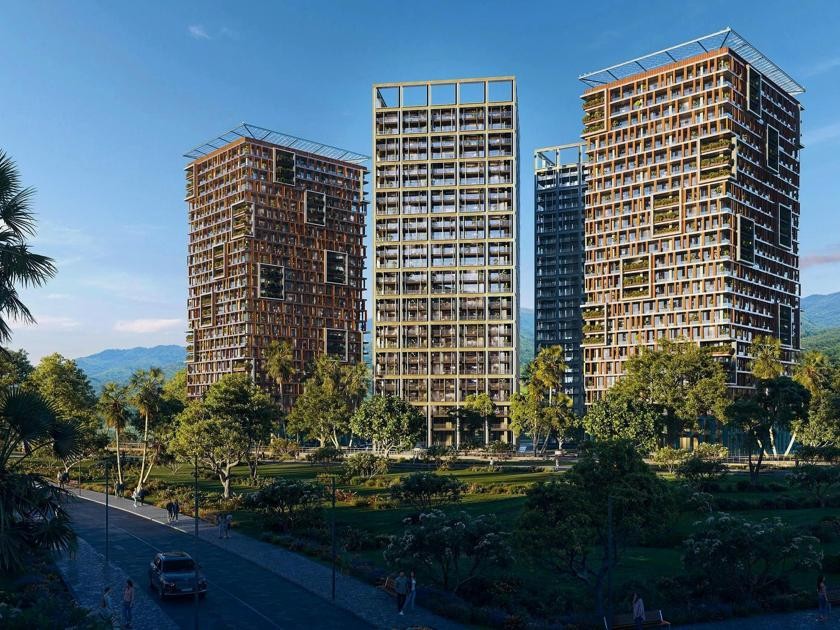
The project is designed with an emphasis on clear geometry and structural precision. It is based on monolithic frame construction technology, which ensures overall rigidity and long-term stability. The volume of the building is perceived as cohesive due to the clear division of the facade into vertical and horizontal segments, where every line follows a unified compositional logic.
The facade is executed in a restrained color palette with contrasting structural elements. Light wall surfaces are framed by dark horizontal inserts running along the balcony lines. This approach enhances the visual rhythm and gives the building a structured appearance. Vertical pylons extending from the ground level to the top slab further emphasize height and create a sense of slender proportions. The absence of excessive decoration reinforces the strict architectural expression and highlights the form itself.
Balconies are designed as cantilevered slabs with precise geometry. The railings feature solid panels, visually uniting the floors into a continuous horizontal line. At the same time, the alternation of open and closed sections adds depth to the facade and enhances its plasticity. Visual dynamics are achieved through repeating elements arranged in a strict order. Window openings are rectangular and organized into a regular grid. Their placement emphasizes facade symmetry and reinforces the sense of order. The glazing size is carefully balanced between light transmission and maintaining a clear facade structure. Frames are integrated into the overall composition without unnecessary accents, supporting the restrained character of the design.
The ground level is distinguished by an open space beneath the building, where parking spaces are located. This solution lightens the visual perception of the lower level and creates the effect of a “raised” volume. The columns supporting the upper floors become part of the overall composition, adding rhythm and depth. The roof is designed as a flat structure with a clearly defined silhouette. The upper line of the building is emphasized by a straight parapet that completes the composition and defines its boundaries. The absence of complex forms at the top supports the overall clarity and geometric consistency.
At night, the building reveals itself through an architectural lighting system. Light accents run along key facade lines, highlighting balcony horizontals and vertical structural elements. Night illumination enhances the graphic quality of the volume, emphasizes its structure, and makes the silhouette more expressive within the surrounding development. As a result, the project forms a cohesive and laconic appearance based on precise proportions, repetition of elements, and a clear compositional scheme.
Vertical circulation between floors is ensured by imported elevator equipment designed for stable and smooth operation under constant load. Engineering safety is reinforced by autonomous fire protection systems, including sensors, detectors, and alert systems. All elements comply with established standards and are designed for rapid response in emergency situations. The entrance group is adapted for people with reduced mobility: slopes and access solutions are provided to ensure convenient movement across all building levels. Interior public areas and lobbies are finished with high wear-resistant materials, reducing the need for frequent maintenance and preserving a neat appearance under intensive use.
The complex is positioned as a precisely engineered format with a focus on structural durability, long-lasting finishing materials, and clear organization of all functional elements.
Landscaping of the internal territory
Monitoring within the courtyard and along the perimeter is organized through an extensive video surveillance system. Cameras are placed at key movement points: entrance groups, access roads, and internal pathways. Recording is continuous with the possibility of further analysis. This allows tracking events, monitoring movement routes, and responding promptly to unusual situations. It also increases transparency in property management and the use of the surrounding area.
The courtyard layout follows a clear functional distribution logic. The space is divided into separate zones with different purposes: quiet relaxation, children’s activity, and transit routes. Pedestrian paths are designed according to everyday movement scenarios, reducing flow intersections and simplifying navigation. Routes are planned to minimize unnecessary movement and shorten travel time between key points, improving overall space efficiency.
Landscape design is executed in a restrained manner with an emphasis on order and ease of maintenance. Lawns are kept neat, shrub groups are compactly arranged, and trees are evenly distributed without excessive density. This approach simplifies maintenance and preserves a clean appearance throughout different seasons. The absence of visual overload improves perception and facilitates maintenance of engineering infrastructure running through the courtyard.
Lighting is organized on a multi-level principle. Fixtures are installed along pedestrian paths, near entrances, and at key movement nodes. Light is distributed evenly without sharp brightness contrasts, reducing eye strain at night. This also enhances safety and improves route visibility in the evening.
The engineering structure is designed for stable long-term operation. All key systems are interconnected and designed for extended use without frequent intervention. Rational courtyard organization, video surveillance control, and well-calibrated technical solutions ensure stable operation and long-term preservation of performance characteristics.
Apartment sales
The residential complex on Airport Highway 82v offers a limited number of apartments designed for private living and efficient space distribution. The range includes compact one-bedroom units as well as larger two- and three-room options. The variety of layouts allows choosing configurations for different purposes — from personal residence to investment with rental potential. One-bedroom units are particularly practical in this context, as their parameters and internal structure are optimized for stable rental demand.
Ceiling heights reach up to 3 meters, significantly enhancing the perception of interior space. Additional vertical volume provides greater flexibility in interior design, simplifies the placement of decorative elements and engineering solutions, and improves air circulation, making spaces easier to adapt for different use scenarios. Panoramic glazing enhances natural light and visually increases room depth. This reduces reliance on artificial lighting during the day. The building gains expressiveness through large glass surfaces. Open balconies expand functionality, allowing use for relaxation, storage, or additional purposes.
Apartments are delivered with basic preparation suitable for further finishing. Internal engineering networks are already installed, simplifying equipment connection and reducing the scope of additional work. Interior partitions are built according to the layout, defining clear functional zoning and structuring the internal arrangement. The floor base is completed as a level screed ready for various finishes such as parquet, tiles, laminate, or linoleum. Wall surfaces are prepared for final finishing, accelerating the transition to the final stage of renovation and reducing preparation effort.
The level of readiness allows owners to flexibly design interiors according to their needs. Basic works are already completed, making it possible to proceed directly to selecting materials, furniture, and decorative elements. Quality control is also simplified at all stages of renovation. This delivery format is intended for those who plan individual design and want to maintain freedom in choosing style and interior organization.
Financial conditions include full payment or mortgage options through a partner bank. This allows flexible budget planning and convenient payment scheduling.
The residential complex on Airport Highway 82v is a modern project with clear engineering logic and a well-thought-out structure. Rational layouts, technical precision, and strong liquidity parameters make it an attractive option both for personal use and for investment with future returns.
Maybe you are interested in other projects


Which apartments are available for sale in Airport Highway, 82v in Batumi?
For sale are apartments.