


Frederick Monperre Street, 12
Layouts and prices for building on Frederick Monperre Street, 12


Frederick Monperre Street, 12 on the map of Tbilisi
Object documents
Mortgage in Frederick Monperre Street, 12
Project characteristics
| 🟧 Number of buildings | 1 |
| 🟧 Number of floors | 6 |
| 🟧 Construction technology | monolithic-frame |
| 🟧 Elevator | yes |
| 🟧 Cadastral number | 01.72.14.068.158 |
| 🟧 Parking | underground parking (16 parking spaces) |
| 🟧 Apartment renovation | green frame, fully renovated |
| 🟧 Apartments area | 32–84 m2 |
| 🟧 Number of apartments | 46 |
Information about the project
Residential complex on Frederique Monpere Street, 12 in Tbilisi is a multi-apartment building with a focus on high construction quality and well-thought-out operational characteristics. It is based on a combination of proven construction technologies and modern engineering systems, making the property attractive for buyers oriented toward practicality, reliability, and everyday comfort.
Advantages
- housing designed for efficient use of space;
- developed location with favorable conditions for everyday needs;
- road connections with quick access to main highways;
- high quality of construction works;
- enhanced sound insulation;
- ceiling height up to 3.0 m;
- large window openings and open balconies;
- energy-efficient double glazing;
- low-noise elevator equipment;
- gated courtyard with organized landscaping;
- security system with 24-hour monitoring;
- landscaping with decorative and functional elements;
- multi-level courtyard lighting scheme;
- dedicated recreation areas;
- aesthetically designed entrance group;
- underground parking for residents’ vehicles;
- wide access roads for free vehicle movement;
- connection to main engineering networks;
- European-style layouts with rational configuration;
- competitive pricing;
- flexible financial purchase terms;
- developer with an active development strategy.
Location
The residential complex on Frederique Monpere Street, 12 is located in the Didi Digomi district, which stands out for its large amount of greenery and natural areas, positively influencing the overall perception of the environment and making it more comfortable for everyday living. The surroundings are suitable for regular walks, outdoor recreation, and active leisure without the need for long-distance travel.
A park area with a developed network of alleys is located nearby. The space is used for walking, sports, and quiet relaxation. The presence of green areas positively affects the microclimate: noise levels are reduced, air circulation improves, and natural protection from overheating appears during warm periods. Such conditions contribute to maintaining physical well-being and recovery after a working day.
The ecological situation of the district is characterized by the absence of large industrial enterprises. This reduces air pollution levels and makes the environment more suitable for long-term living. Clean air and greenery play an important role for people who pay attention to health and environmental quality.
The location combines developed infrastructure and natural surroundings, expanding the ways the area can be used. Access to necessary services is combined with opportunities to spend time outdoors, maintaining a balance between activity and relaxation. This location remains relevant in the long term and is in demand among buyers seeking stable living conditions and a favorable ecological environment.
Local infrastructure
The surroundings of the new development include a wide range of services focused on everyday needs. Pharmacies and small-format grocery stores operate within a few minutes’ walk, allowing quick purchase of essential goods without significant time expenditure. The well-planned distribution of retail outlets simplifies daily routines and makes everyday shopping more efficient.
Within two kilometers, there is a variety of dining establishments. Cafes, restaurants, pizzerias, and fast-service outlets cover different price categories and culinary preferences. This allows choosing a leisure format depending on preferences — from short meetings to extended time outside the home. A large number of establishments also increases the attractiveness of the area for rental purposes.
The medical infrastructure is represented by several institutions located nearby. Among them are the Imedi clinic, dental offices, and specialized medical centers.
Schools No. 186 and No. 192 are located nearby, simplifying the organization of the educational process and reducing the burden associated with daily travel. A short route to educational institutions is especially important for families with school-age children.
Additionally, within a ten-minute drive, specialized medical institutions are available: a children’s polyclinic, the Zhvania pediatric clinic, the Jo Ann clinic, and the O. Gudushauri medical center. The presence of these institutions expands the range of medical services — from basic consultations to specialized treatment.
Overall, the infrastructure covers key areas — retail, dining, education, and healthcare. This reduces dependence on distant services, simplifies daily routes, and increases the functionality of the location for permanent residence and investment.
Transport interchange
A major road runs in close proximity to the residential complex, integrated into the main road network of the capital. This reduces travel time between different districts and simplifies trips outside the city. Transport logistics are designed with high road capacity in mind, reducing the likelihood of delays during peak hours and making daily routes more predictable.
The nearest stop is located 420 meters from the new building. The interval between services is about 10 minutes, allowing trips to be planned without long waiting times. The following routes operate in this direction:
- buses No. 302, No. 311, No. 314, No. 315, No. 321, and No. 335;
- minibuses No. 422, No. 442, No. 460, No. 518, No. 539, and No. 541.
The extensive route network covers various directions of the capital and nearby settlements, making public transport a full-fledged alternative to a private car.
Special attention should be paid to the direct connection with the metro. Route No. 321 goes to the Sarajishvili station, located eight kilometers away. Travel time is approximately 15–20 minutes, with no transfers required. This increases mobility efficiency and allows quick access to the city metro system.
For intercity travel, the Didube bus station and railway station are available. The distance to them is about seven kilometers, making travel within the country convenient and fast. The central railway station is ten kilometers away, providing additional opportunities for long-distance and interregional travel.
Shota Rustaveli International Airport is located at a distance that can be reached by car within about one hour. Travel time depends on traffic conditions, but the route remains relatively direct and straightforward.
The road infrastructure in this location is characterized by diversity and high connectivity. The presence of multiple transport options, a well-developed route network, and proximity to key transport hubs allow flexible planning of daily and long-distance trips, optimizing travel time and reducing dependence on a single mode of transport.
General characteristics
The residential complex on Frederique Monpere Street, 12 is represented by a six-storey building, the design of which takes into account the climatic conditions and geological features of the region. These factors directly influenced the choice of structural scheme and the materials used.
The structure is based on a monolithic reinforced concrete frame designed for significant loads and long-term operation. This technology increases structural stability, reduces the risk of deformation, and helps maintain the technical characteristics of the property over many years. The materials used comply with international standards, which positively affects energy consumption and operating costs.
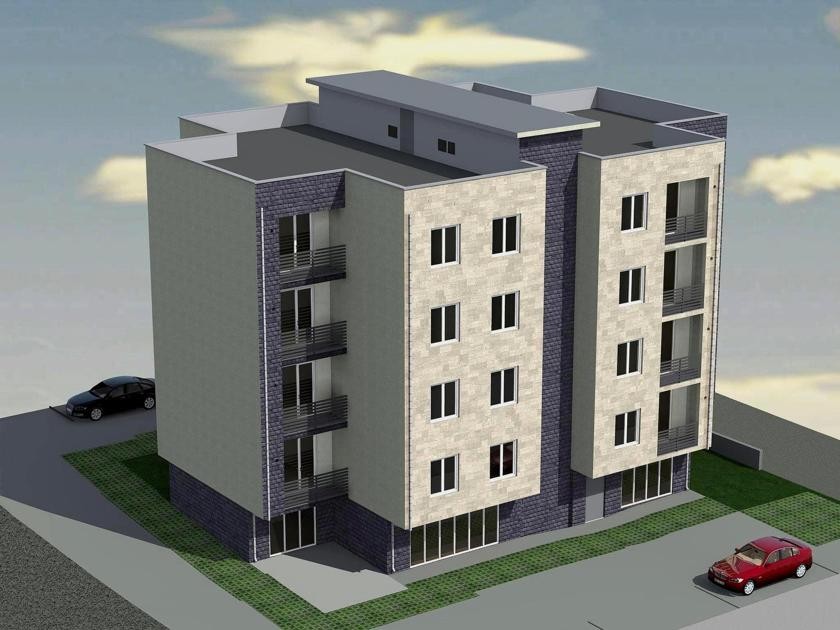
The building is designed with an emphasis on conciseness and clarity of form. The facades highlight geometric lines combined with expressive vertical and horizontal elements, giving the appearance a strict yet lightweight character. Vertical projections of the facades are accentuated with warm-toned finishing materials, creating visual segmentation of volumes and emphasizing the rhythm of the building. This prevents monotony and adds depth to the perception of the structure.
The front side is highlighted by large glazed balconies with transparent railings, allowing natural light to enter the interiors and forming an open external image. Balcony sections are neatly aligned along the entire facade, and their uniform arrangement emphasizes proportionality and symmetry. On the side elevations, more compact loggias with metal railings are placed, adding variety and balancing the overall composition. The flat roof is covered with reliable waterproofing, allowing it to be used as a technical zone for engineering systems. The foundation is raised on a low plinth, creating a visual separation between ground level and residential floors.
Special attention is given to facade finishing details: wall textures combine smooth surfaces with relief inserts, adding dynamism and a sense of lightness. The color palette is based on natural tones — light beige and terracotta shades that harmonize with the surrounding environment. This allows the complex to integrate organically into its surroundings without excessive contrast or overly bright solutions. Balcony and loggia finishes are made of modern materials resistant to weather and wear, ensuring durability and preservation of appearance over many years. The structures feature a high degree of transparency and a minimalist design that emphasizes lightness and simplicity.
At night, the building attracts attention with soft architectural lighting integrated into facade elements. The lighting highlights relief details, creating an expressive interplay of light and shadow that enhances the visual appeal of the facades in the evening. It emphasizes key lines, adding aesthetics and highlighting construction quality.
Thus, the architecture of the complex on Frederique Monpere Street, 12 represents a balanced combination of minimalist forms and functional elements enhanced by color and lighting. The project demonstrates thoughtful use of volumes and textures, creating an effect of refined simplicity without excessive decoration. A high level of finishing and attention to detail emphasize the intention to make the building not only attractive but also durable and adapted to residents’ needs.
The entrance group is designed with barrier-free access for people with limited mobility. Common areas are finished with highly wear-resistant materials: walls are covered with decorative plaster, and floor surfaces are made of porcelain stoneware. These materials are designed for intensive use and maintain a neat appearance over time. The layout of lobbies and corridors is focused on practicality and ease of maintenance. Engineering systems are connected to main utility networks, ensuring stable supply of water, heat, and electricity. Fire protection systems with sensors and alert systems are installed, along with intercom access control. Elevators are designed for high load capacity and provide fast movement between floors.
The technical concept of the building is based on a rational selection of structural and engineering elements. All components — from the load-bearing frame to finishing materials — are focused on long-term use, reduced maintenance costs, and preservation of operational characteristics. This approach increases reliability and ensures resistance to wear over time.
Landscaping of the internal territory
The adjacent area is organized with a focus on practicality and long-term visual stability. The layout is designed according to daily usage scenarios: movement, recreation, and vehicle placement. The entire structure follows a clear logic, simplifying orientation and reducing chaotic movement.
Driveways are wide enough for smooth traffic flow, while pedestrian paths are separated, improving safety. Surface materials are selected for long-term use, resistant to wear, temperature changes, and mechanical loads. The geometry of the дорожной network is carefully planned, minimizing unnecessary intersections and making movement predictable.
Landscaping is a key element of the courtyard’s visual structure. Lawns are maintained in a neat condition, flower beds are organized with seasonal plant changes in mind, and decorative shrubs add depth to the composition. Trees are planted considering canopy growth and sunlight exposure, maintaining a balance between open and shaded areas. Greenery improves the microclimate, reduces dust levels, and creates comfortable conditions for outdoor activities. Recreation areas are integrated into the green framework and are suitable for short daily leisure.
Dedicated areas for adults are equipped with fixed benches and are located away from driveways. This placement increases privacy and expands the ways the courtyard can be used — from quiet relaxation to informal communication. The underground parking reduces the load on the surface level, frees up space, and organizes vehicle placement. Entry and exit points are designed with traffic flow in mind, minimizing intersections with pedestrian routes. Street lighting is arranged based on traffic intensity and key zones, including entrances, paths, and recreation areas.
Additional engineering elements are aimed at preserving the operational characteristics of all surfaces and structures. Solutions are used to reduce wear and simplify maintenance. As a result, a structured environment is created with a clear distribution of functions, where all elements operate cohesively and maintain a neat appearance over time.
Apartment sales
The residential complex on Frederique Monpere Street, 12 offers apartments focused on efficient use of space and flexible layouts. Configurations are designed for different living scenarios, expanding the range of potential buyers and increasing the practical value of the property. The internal layout is structured around everyday needs, without unnecessary elements or inefficient transitions.
Buyers are offered compact studio units of 30 m², as well as more spacious two-, three-, and four-room apartments with total areas starting from 50 m². Layouts include an open kitchen-living area with sufficient space for dining and relaxation zones, a separate bedroom, a spacious bathroom, and an open balcony. Additional balcony space expands functionality, allowing for outdoor relaxation, a workspace, or a small garden. This layout makes the apartments suitable both for permanent residence and rental purposes.
Apartments are available with basic preparation for further interior finishing. Internal utility wiring is already completed, including electrical networks and main systems, which accelerates equipment installation and reduces the scope of further work. Partitions are installed according to the layout, clearly dividing functional areas and establishing logical organization.
Floors are leveled with screed suitable for installing various coverings — parquet boards, tiles, laminate, or linoleum. Walls are prepared for finishing materials, reducing preparation work. This level of readiness allows faster transition to decorative design and focus on the visual aspect of the interior. Interior design planning, selection of finishing materials, and furniture remain fully customizable, allowing adaptation to personal requirements. The prepared base simplifies renovation organization, improves quality control, and optimizes timelines.
The financial model includes several payment options. Conditions are tailored to the client’s budget and preferences, including flexible payment schedules. Sales consultants provide detailed explanations of financing tools, timelines, and legal aspects, simplifying decision-making and reducing potential risks.
The complex on Frederique Monpere Street, 12 is focused on practical real estate with carefully balanced characteristics. The concept is based on attention to engineering quality, execution standards, and layout versatility. This increases liquidity, ensures long-term demand, and allows adaptation of interior space to changing needs without significant additional investment.
Construction company
The developer is The House Dighomi — a company whose reputation since 2025 has been associated with a high level of responsibility and the implementation of advanced construction technologies. Its activities are based on a focus on energy-efficient technologies and engineering innovation. These principles define the direction of development and influence the technical characteristics of future residential projects. The completed buildings are designed for long-term operation, resistance to external factors, and efficient use of resources with minimal environmental impact. This ensures a balance between expressive architecture and functional efficiency, maintaining long-term investment attractiveness.
The company places priority on the quality of construction materials and precision in technological processes. All stages are consistently monitored — from design to completion and commissioning. Internal regulations cover all processes and comply with strict industry standards. This approach maintains consistent quality and reduces the likelihood of technical deviations. At the same time, continuous work is carried out to improve construction standards, with a focus on engineering solutions designed for long-term use and high safety levels.
A separate focus is placed on environmental characteristics. Projects incorporate energy-saving technologies, efficient engineering systems, and structural solutions aimed at reducing operating costs. These measures increase economic efficiency and improve performance indicators. Attention to detail at every stage ensures structural reliability and resistance to wear.
The strategy of The House Dighomi is focused on delivering projects with predictable technical characteristics and long service life. The company demonstrates a systematic approach to construction, where engineering precision, quality control, and technological development are key factors. This strengthens trust among buyers and confirms the brand’s stable position in the real estate market.
Maybe you are interested in other projects




Which apartments are available for sale in Frederick Monperre Street, 12 in Tbilisi?
For sale are studios, 2-room, 3-room, 4-room.